Overview
A motor drive or an industrial controller must run a real-time loop, read several analog channels and talk to a network, all at a low cost. GigaDevice's GD32 microcontrollers cover the range with the Arm Cortex-M3 and Cortex-M4 cores, and the GD25 serial NOR Flash stores the firmware and the parameters. BeiLuo supplies both with genuine traceability and FAE support. This page shows how they fit together in a motor and industrial control design.
The Control Core
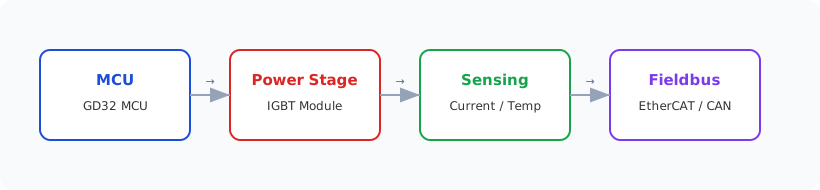
The control core runs the loop that regulates the current and the speed, and the choice of core follows the algorithm. A field-oriented motor control benefits from the Cortex-M4 floating-point unit and the digital-signal-processing instructions, so the GD32F303 is a good fit, while a simpler control or a communication and housekeeping task uses the Cortex-M3 GD32F103. Both run at up to about 108 to 120 MHz with on-chip flash and SRAM, and both use the familiar Arm toolchain, so the software can be reused across the range.
Real-Time Timers and ADC
The advanced-control timer generates the complementary PWM with dead-time for the three half bridges, and the multiple 12-bit ADC units sample the phase currents and the bus voltage for the control loop. The GD32F303 brings three ADC units and two DACs, which is enough for a three-shunt current measurement and a reference output, and the timer and ADC interaction is what makes the loop deterministic.
The Power Stage and the Sensing
The power stage switches the motor current, and it is usually an integrated module or a discrete bridge driven by the MCU. The current and the bus voltage are sensed with a shunt or an isolated sensor and fed to the ADC, and the measurement accuracy decides the torque control and the protection. Keep the analog front end close to the ADC and away from the switching nodes, and filter the signal as the control bandwidth requires.
Communication
The controller talks to the rest of the system over a network such as CAN, and the GD32F103 provides a CAN 2.0B interface together with SPI, I2C, USART and USB. This lets one device run the motor loop and the network communication, which suits a compact drive. Where more than one MCU is used, the GD32F303 can run the fast loop and the GD32F103 the housekeeping, sharing the data over a serial link.
Firmware and Parameter Storage
The firmware, the calibration and the configuration are stored in a GigaDevice GD25 serial NOR Flash, which the MCU reads in place at boot. The uniform 4 KB sector makes a parameter update simple, and the write protection and the security registers keep the boot code safe. Because the flash and the MCU come from the same supplier, the combination is well matched and the support is consistent.
Migration and Reuse
The GD32 family shares the Arm Cortex-M core and a similar peripheral set, so a firmware written for a comparable part can often be ported with modest changes. Confirm the peripheral differences, the clock tree and the timing for the specific part, and use the GigaDevice firmware library to shorten the port.
Thermal and EMC Design
An industrial drive runs in a warm cabinet and switches a large current, so the thermal and the EMC design matter. Keep the power stage and the analog front end separated, use a ground plane, keep the switching loops small and provide the decoupling the MCU datasheet recommends. Verify the design across the temperature range on the bench before you release it.
Getting Help
Send your motor or load type, the control method, the interface and the environment to our FAE team and we will propose an MCU and a flash, help choose the core and the storage and review the layout. BeiLuo holds mainstream GD32 MCUs and GD25 flash in regional stock and ships them with an import declaration, a certificate of origin and a RoHS compliance file, so a motor and industrial control design can move from prototype to production without a supply gap.